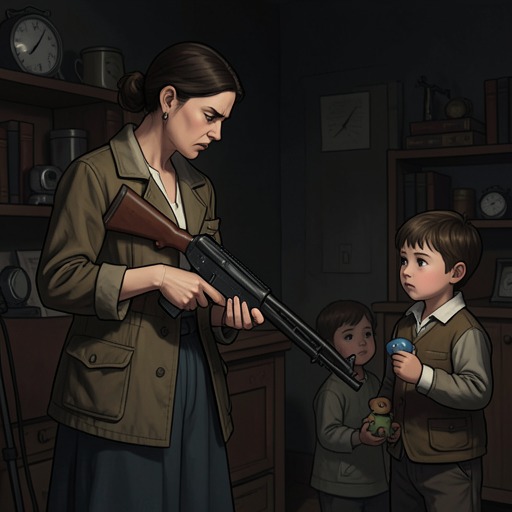
The bank robber and her daughters
Anxious PeopleThe relationship between the Bank robber and her daughters is the intimate counterweight to her failed bank robbery: her fear of losing a stable life with them helps drive her desperate decision, while their affection remains visible in small, habitual gestures. The girls are not simply the reason she acts; they are people with their own humor and tenderness, whose presence follows her into the crisis in the form of a drawing tucked into her pocket.
Family Life and Private Language
The Bank robber’s daughters are close to one another as well as to their mother. Although sisters are often expected to quarrel, the girls rarely do. The younger one can play in the older one’s room without being shouted at, and the older one can keep her treasured belongings without her sister deliberately breaking them. When the girls were very small, their parents privately wondered whether they deserved such considerate children.
Their mother’s names for them turn that affection into a private family language. She does not use their given names, instead calling them by the animals they seemed to resemble before they were born: one had seemed to jump about, the other to climb. The animal identities also gather the family into a playful image of protection: an elk willing to do anything for the two smaller creatures, even when doing so would be foolish. The names are not formal labels so much as a way of recalling how the girls felt to their mother, and how completely she has organized her sense of responsibility around them.
Shared Routines and the Drawing
After the divorce, the girls spend different weeks with each parent. On mornings when they live with their mother, they take the bus, a journey they enjoy because it becomes an occasion for inventing stories about the other passengers. Their mother proposes that one stranger might be a firefighter; the younger daughter imagines another as an alien. The older daughter adds an outrageous possibility about a wanted stranger, making the women nearby uncomfortable and the sisters laugh. Their mother has to pretend to disapprove, even as the family game carries them along.
They are often late for the bus. As they run across the bridge toward the bus stop on the other side, the girls cry out that the elk is coming, laughing at their mother’s long legs and the way she runs. The teasing depends on familiarity, not distance: the children notice a physical detail adults might overlook, and turn it into a recurring joke shared by all three. The story presents this as one of the ways children reach what is vulnerable in a parent, while still loving that parent despite her imperfections.
The younger daughter’s drawing provides another, quieter sign of attachment. She has drawn a frog, a monkey, and an elk, then slipped the picture into her mother’s pocket without her realizing it. The Bank robber leaves home carrying it. As the crisis unfolds, the drawing is more than a reminder of her children: it is a small, unannounced act of care that has traveled with her into the moment when she is most afraid of failing them.
Divorce and the Fear of Losing Her Children
The divorce changes the practical conditions of family life. The apartment belongs legally to the other parent, and the Bank robber does not contest it or try to turn the separation into a fight. She is also without the security of a job and savings, making it difficult to find another home. She accepts these losses because she does not want the girls exposed to a prolonged war between their parents. Her decision to avoid conflict is protective in intention, but it leaves her with fewer ways to provide for them.
Her fear is intensified by her own childhood experience of family instability. She remembers how children can learn to hide an adult’s problems, inventing ordinary explanations and shielding a parent from outside scrutiny. Determined not to make her daughters bear that burden, she avoids seeking help from the welfare office because she fears the girls could be taken away. She tries to manage the crisis alone. Even when she finds work, her first month’s wages are withheld, and the bank refuses her a loan because the job is not permanent. Her efforts to maintain a household therefore leave her more, not less, exposed to the threat of losing it.
The pressure becomes immediate around the New Year. The girls are due to spend New Year’s Day with her, while a lawyer’s letter threatens her custody and a notice from her landlord says that rent must be paid or she will be evicted. Faced with these demands, she carries the latest letters in her pocket alongside the fear that she cannot secure a home for the children. The story links her decision to rob the bank to this convergence of financial need and parental panic, rather than presenting it as an isolated act of greed.
The Bank Robbery and Its Meaning for the Family
The Bank robber enters the bank intending to obtain 6,500 kronor for rent, telling herself she will return the money after she is paid. She uses what she believes is a toy pistol and makes a ski mask from a black woolly hat. The weapon later proves to be real. The difference between what she believes she is doing and the danger of what she has actually done marks the widening gap between her intention to protect her family and the consequences of her choice.
At the apartment where hostages are being held, she admits that she had not wanted to cause trouble with her husband, had hoped to sort out the situation herself, and now believes she has made a mess of everything. She says she is ready to give up and promises to release the hostages, adding that the pistol is still inside and is not real. Her explanation makes the family conflict plain: she has tried to preserve the girls from parental conflict and insecurity, but secrecy and isolation have helped bring about a much more dangerous crisis. Jim recognizes that fear of conflict has become part of the reason she robbed the bank, and struggles to see her only as a criminal rather than as a parent in distress.
The Daughters as a Measure of Love and Vulnerability
The Bank robber’s daughters shape both the motive and the emotional register of her story. Their jokes about the running elk and their drawings make family affection concrete, while the custody threat and the loss of housing reveal how vulnerable that affection is to circumstances beyond their control. The book holds these facts together without treating parental love as proof that every choice is harmless: the mother’s devotion helps explain her desperation, but does not erase the danger created by the robbery.
The drawing of a monkey, a frog, and an elk condenses that tension. It is an ordinary gift made without ceremony, carried unknowingly into a crisis, and bound to the family’s private names for one another. Alongside the bus games and the sisters’ easy intimacy, it shows that the children’s relationship with their mother is made not only of her promises to protect them, but of small acts of attention moving in both directions. The family’s closeness survives in the narrative as a source of tenderness and as the measure of what the Bank robber fears she may lose.